
Every building demolition releases tonnes of metal: reinforcing steel embedded in concrete, structural steel frames and profiles, aluminium joinery, zinc roofing, copper pipework, electrical cables, boilers and equipment. In Morocco, demolition and renovation sites are multiplying — old buildings in city centres, disused factories, public buildings to renovate, old houses — and the scrap they produce is among the most abundant in the construction sector. For a project owner or a demolition company, organising this recovery well means recovering value from an expensive site, reducing waste sent to landfill and handing over a clean site. This guide explains what demolition scrap is, how to practise selective deconstruction, how to recover reinforcing steel from concrete and how to prepare a demolition site before collection.
First point to understand: demolition scrap is not picked up afterwards, it is prepared before the demolition. A building knocked down by an excavator without prior sorting mixes steel, aluminium, copper, wood, plaster and concrete into a single pile that is hard to recover. A building deconstructed selectively — first the equipment and joinery, then the structure — delivers clean metals, sorted by family, that recover much better. Our article on construction site scrap describes scrap from construction sites; this one covers demolition, where the metal is already in place and waiting to be recovered.
What is demolition scrap?
Demolition scrap is made up of several families. Reinforcing steel first — the rebar embedded in concrete slabs, columns and walls — which is the largest share of the metal in a concrete building. Structural steel and profiles next: beams, columns, I-beams and U-profiles, steel frames, staircases and steel walkways. Aluminium joinery: windows, doors, facades, verandas, railings. Roofing: sheets, cladding, zinc and gutters — our article on recovering industrial sheets and roofing details these materials.
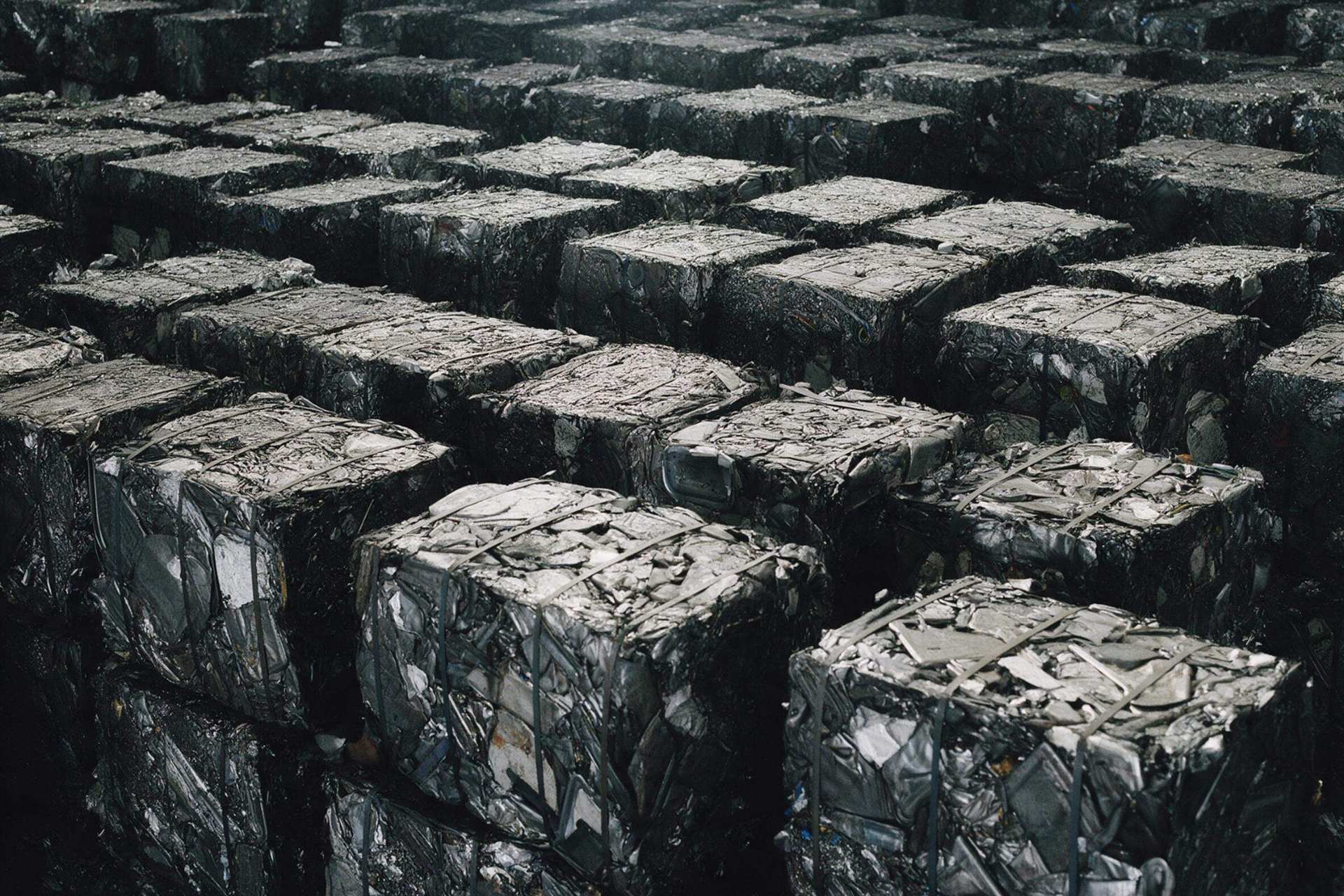
Pipework and plumbing add copper and brass: water pipes, taps, risers. Electrical cables — copper — run through the whole building, from the panels to the sockets. Equipment: boilers, air-conditioning units, lifts, pumps — our article on scrap metal from lifts and lifting equipment details this equipment. Heavy scrap — profiles, frames, beams — is distinguished from light scrap — sheets, cables, joinery: the heavy is cut and loaded by crane or grapple, the light is compacted into bales. An inventory before demolition makes it possible to estimate each family before starting.
Selective deconstruction: the inventory before demolishing
Selective deconstruction means demolishing in the reverse order of construction: first what can be dismantled, then what is broken. Before the machines arrive, the recoverable materials are inventoried, item by item: joinery, equipment, cables, boilers, sheets, accessible profiles. Then the aluminium joinery, the equipment still in good condition, the cables and copper pipework, the boilers and air-conditioning units are removed. What can be reused — a door in good condition, a sound profile, working equipment — goes to reuse. What cannot be reused goes to scrap, sorted by metal.
The benefits are concrete: more metal recovered, clean lots that recover better, less mixed waste to dispose of, a cleaner and safer site. One legal point to clarify before starting: who owns the scrap from the building? The project owner, the demolition company, or the collector who buys it? The answer must be written in the demolition contract, before the first excavator blow. Photos and estimated quantities from the inventory are then used as a basis for organising collections: number of trucks, type of skip, schedule. For the tender sale procedure, which applies to demolished public buildings, read our article on scrap metal from public administrations and local authorities.
Reinforcing steel: extracting steel from concrete
Reinforced concrete is the most common material in Moroccan buildings — and its steel is the most abundant metal in a demolition. Steel is only a small share of the volume of reinforced concrete, but it is almost all of the metal value of the rubble. To recover it, the concrete is crushed: blocks of reinforced concrete go through a crusher, which breaks the concrete and frees the steel bars. Separation is then done by magnet: magnetic separators placed above the conveyor belts attract the steel and separate it from the concrete aggregates. This is the most effective method for recovering reinforcing steel, and it works on site as well as in a processing facility.
Bars freed from the concrete are cut with a disc cutter or shears, then bundled for transport. Welded mesh and grilles are cut with bolt cutters. An important point: surface rust does not prevent remelting. Reinforcing steel goes to the foundry to be remelted — it is not reused as it is in a load-bearing structure — so rusty steel remains recoverable. The concrete aggregates from crushing are reused as fill or road sub-base. Our article on construction site scrap also describes construction waste sorting, and our article on sorting metals in a company the sorting method by metal.
Structural steel and profiles: reuse before remelting
Structural steel and profiles deserve special treatment: when they are in good condition, they can be reused. An I-beam, a column, a portal frame dismantled cleanly — without torch cutting, with the bolts removed — can serve in another construction or be reshaped. Demolition guides recommend dismantling steel sections intended for reuse with care, storing them flat on pallets or timber skids, away from machine movements, to preserve their condition. Profiles intended for recycling need less care: they are cut on site and go in a skip to sorting.
Aluminium joinery is removed whole: the glazing and seals are taken out, the aluminium profiles are separated from the steel fittings, and each metal goes to its lot. Sheets and cladding are dismantled panel by panel and compacted. Railings, grilles and metal staircases are cut into transportable sections. In all cases, the rule is the same: dismantle before breaking, sort by metal at source, and never mix steel, aluminium and copper in the same skip. A well-sorted demolition lot recovers better and is collected faster — our article on dismantling industrial machines in Morocco applies the same logic to factory equipment.
Safety and obligations on a demolition site
A demolition site is a dangerous site, and scrap recovery must never come before safety. First reflex: depollution before any cutting. Refrigerants in air-conditioning units, oils in boilers and equipment, batteries, live cables and gas pipes must be handled by professionals before dismantling. Never cut a cable or a pipe without checking: a cable may be live, a pipe may contain gas or a fluid. Electrical equipment is isolated before being dismantled.
Second reflex: hazardous waste. Old buildings may contain asbestos — in roofing, suspended ceilings, pipes — and lead paint. These materials are never mixed with scrap: they must be diagnosed and removed by a specialised company, before demolition. Third reflex: personal protective equipment — helmet, gloves, glasses, safety shoes — and coordination with the demolition company, which runs the site and defines the work zones. For the general regulatory framework, read our article on the legal obligations for metal waste in Morocco and our article on scrap metal buyback step by step.
What happens to demolition steel?
After collection, demolition steel goes to a sorting centre, where it is identified, sheared, cut and compacted, then to the foundry, where it is remelted — most often in an electric arc furnace — into new raw material. Remelted steel becomes new profiles, sheets and reinforcing bars: steel recycles infinitely without losing its properties, and every tonne of recycled steel avoids mining iron ore. Copper from cables and pipework becomes ingots or new cables, aluminium from joinery becomes alloy ingots. Our article on scrap metal from sorting centres and recycling facilities describes this sorting stage.
For the project owner, recovering demolition scrap is both revenue that reduces the cost of the site and a circular economy gesture: recycled metal replaces virgin ore, and the site is handed over clean, without piles of metal rubble. MOUMETAL works throughout Morocco on demolition sites: visit before demolition to inventory the metals, coordination with the demolition company, on-site sorting by metal, weighing and documentation of flows, collection by truck at site times. To organise a visit before demolition, contact us: +212 660 690 806 — contact@moumetal.com. And to place demolition in the wider recycling picture, read our page scrap collection and removal and our article on metal sorting.
FAQ — Scrap metal from building demolition
What should be done with demolition scrap? Inventory it before demolition, sort it by metal — steel, aluminium, copper, stainless steel — and collect it by truck, lot by lot. Selective deconstruction — removing joinery, equipment and cables first, then demolishing the structure — recovers more metal than demolition without sorting.
How do you recover reinforcing steel from concrete? By crushing the reinforced concrete, then separating the steel by magnet: magnetic separators above the conveyor belts attract the steel bars and separate them from the concrete aggregates. The freed bars are cut and bundled for transport. Surface rust does not prevent remelting.
Who buys demolition scrap in Morocco? Metal collection and recycling companies, whose trade register entry mentions scrap dealing or ferrous and non-ferrous waste processing. MOUMETAL works on demolition sites throughout Morocco, with a visit before demolition, on-site sorting and full traceability. Ownership of the scrap must be clarified in the demolition contract before the site starts.
Should metals be sorted before demolition? Yes: selective deconstruction — inventory, removal of joinery and equipment, then demolition of the structure — recovers more metal, delivers clean lots that recover better and reduces mixed waste to dispose of. A building demolished without sorting mixes steel, aluminium and copper into a single pile that is hard to recover.
What happens to steel from demolished buildings? It goes to a sorting centre, where it is sheared and compacted, then to the foundry, where it is remelted into new profiles, sheets and reinforcing bars. Steel recycles infinitely without losing its properties, and the copper and aluminium in the building follow their own remelting channels.
Have your demolition scrap recovered by MOUMETAL
Reinforcing steel, structural steel, aluminium joinery, sheets and cables: MOUMETAL buys and collects scrap metal from demolition sites in Morocco, with a visit before demolition, on-site sorting and full traceability. To learn more, read our page scrap metal purchase and our article on construction site scrap. Contact us: +212 660 690 806 — contact@moumetal.com.